











Gate Course
The gate course in Teach My Little Sister How To Drive has one goal: guide the car through a gate. It sounds like the easiest lesson in the game until you try it. A hands-on report from Tokyo Game Show described the car catching fire before it ever made it through, and that story captures the spirit of the course perfectly. A narrow target, a nervous driver and a passenger who can only talk make even a straight line feel dramatic.
A Test of Precision
Where the S-Curve Course is about changing direction, the gate course is about lining up. The car has to arrive at the opening straight, centered and at a sensible speed. Any drift to one side, any burst of acceleration on the approach, and the gate becomes an obstacle instead of a goal.
That shift in focus changes the kind of instructions you need. Instead of calling turns, you spend most of the course making tiny adjustments and controlling speed. The words “a little” become your most valuable tool.
It is also the course where her habit of adding unrequested actions becomes most obvious. A quick “go” on a straight line can turn into far more speed than you wanted, right at the moment precision matters most.
Lining Up the Approach
The best runs start well before the gate. Get the car pointing straight at the opening while there is still plenty of distance, then keep it there with small corrections. Trying to line up in the last few meters almost never works.
| Distance to gate | Your focus | Example instruction |
|---|---|---|
| Far | Direction | “Turn slightly left so we face the gate.” |
| Middle | Speed | “Keep driving slowly, straight ahead.” |
| Close | Small corrections | “A tiny bit to the right.” |
| At the gate | Stay calm | “Straight, keep going slowly.” |
Notice that the instructions get smaller as the car gets closer. Big turns near the gate swing the car out of line. Gentle, specific nudges keep it centered.
Looking ahead with the mouse makes this easier. Watching the gate itself, rather than the road directly in front of the bonnet, helps you see early whether the car is drifting.
Keeping the Speed Down
Speed is the hidden enemy on this course. A faster car gives every correction less time to take effect, and it turns a small misalignment into a crash. Ask for slow driving early and repeat it if the car starts to pick up pace.
Watch out: avoid one-word commands such as “go” or “faster” on the approach. Short commands can lead to extra actions, and a sudden burst of acceleration is the quickest way to miss the gate.
If the car is going too fast and you are close to the gate, “stop” is a better choice than hoping for the best. A stopped car can be lined up again; a car that hits the frame of the gate at speed cannot.
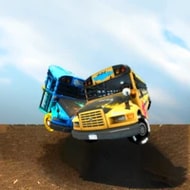
Crashes in this game are physical and spectacular. That is part of the fun, but it also means a bad approach can end with far more drama than a simple bump.
When It Goes Wrong
Missed the gate? Do not try to turn around in one sweeping move. Ask her to stop, then guide her back to a straight line in small steps. Broad requests, such as asking her to return to the starting point, can work, but the result may leave the car facing the wrong way.
Fire, explosions and flying passengers are part of the game’s comedy, and the gate course seems especially good at producing them. If you are recording or streaming, the gate course is often where the most shareable moments happen.
If you simply want to get through, patience is the answer. Slow down, line up, nudge, and repeat.
Why does the car speed up on the approach?
Very short commands can lead her to add actions you did not ask for. Use full sentences such as “keep driving slowly” rather than single words.
Should I correct the line early or late?
Early. Line the car up while it is still far from the gate, then use tiny adjustments to keep it centered.
What if she misses the gate completely?
Ask her to stop, then guide her back into a straight line step by step. Trying to fix everything at once usually makes it worse.
The gate course in Teach My Little Sister How To Drive is short, simple and surprisingly explosive: line up early, keep the speed down, shrink your corrections as the gate gets closer, and the car will roll through the opening instead of bursting into flames in front of it.