









Drive Mad
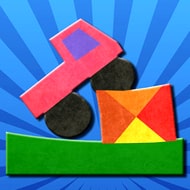







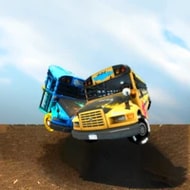
Drive Mad looks like a toy box of blocky trucks and cardboard-simple tracks, but it plays like a balance exam where the throttle is the only pencil you get. There are just two inputs – forward and back – and yet the first time you crest a ramp too fast and watch the truck land on its roof, it becomes obvious that the real control is the tilt of the vehicle, not its speed. Every level is a short obstacle course with a finish line, and the game keeps asking the same question in new ways: can you stay upright while the world tries to flip you?
| Inputs | Two: accelerate and brake/reverse |
| Worlds | 8, including Classic, Winter and Monster Truck |
| Total levels | 365 |
| Classic world | 200 levels |
| Trophies | 24 |
| Bonus goal | Gold time on every level |
Throttle as Steering in Drive Mad
The trick that separates a first-hour player from someone clearing levels on the first attempt is understanding what the two buttons actually do to the body of the truck. Pressing forward pitches the nose up as the rear wheels push; pressing back tips the nose down. In the air that turns the brake into a rotation key, and on a slope it decides whether your front wheels bite or float. Once you stop thinking of the left arrow as a brake and start thinking of it as a lean, the whole game changes.
Short taps beat long holds almost everywhere. Holding an input for too long lets momentum take over, and an overcorrection is the cause of most flips, not the original bad landing. The rhythm good players develop is a series of small pulses: tap to settle the nose, tap to bring it back, release and let the suspension absorb the rest.
The first ten to fifteen levels exist to teach exactly this. They look trivial – a bump, a gap, a gentle hill – but each one is a small lesson in how far the truck rotates per tap. Players who rush through them usually come back later, frustrated, to a level where the same lesson suddenly matters at three times the height.
Worlds and Level Types You Will Meet
The Classic world carries most of the content with 200 levels that rise in difficulty slowly enough that you rarely notice the curve until you look back. Winter adds 25 snowy levels where traction feels less forgiving, and the Monster Truck world swaps your vehicle for one with much larger wheels. That extra weight is the point: small mistakes are harder to correct because the truck carries more rotation once it starts tipping.
Beyond the scenery, the levels are built around recurring mechanics. Magnet levels pull the truck toward metal surfaces if you drive too close. Low and zero gravity stages turn braking into pure balance shifting, since there is little to slow you down. Moving machinery – rotating wheels, conveyors and swinging blocks – asks for timing rather than speed, and hazard stages throw lasers, shockwaves and falling objects into your path.
- Magnet stages: keep a lane of distance from metal unless you want the pull
- Low gravity stages: treat every input as a rotation, not a speed change
- Machinery stages: watch one full cycle before committing
- Puzzle stages: you may need to push objects or build a path from obstacles first
The puzzle-flavored stages are the ones that catch speedrunners off guard. Some of them cannot be cleared by driving well; you have to nudge a block into a gap or knock a piece of the course into position, and only then does the route exist.
Gold Times, Trophies and Why Players Replay Levels
Each level shows a golden bar that drains while you drive. Finish before it empties and the level is marked with a gold time. The shift this creates is subtle but real: once a level turns gold, anything less starts to feel unfinished, and players who were happy just to reach the flag start replaying stages to shave seconds. Gold runs reward the same skill the game teaches everywhere else – fewer, cleaner inputs – because a run with no wobbles is almost always the fastest one.
The 24 trophies push in a different direction. Several are tied to specific levels, such as finishing level 1 while riding on the back wheels, which turns a stage you cleared in seconds into a small balance challenge.
Restarts are instant, and that matters for the feel of the game. A failed jump costs you a couple of seconds, not a loading screen, so experimenting with a wheelie line or a late brake never feels expensive. Players who enjoy trial-and-error puzzles tend to fall into that loop for hours, while those who prefer steady progress can lean on the skip option that appears after three failed attempts.
Where Drive Mad Gets Divisive
The level skip is the most debated feature. It is offered after three failures in exchange for watching an ad, which some players see as a fair safety valve and others see as a shortcut that hollows out the satisfaction of finally cracking a hard stage. Completionists usually avoid it, because a skipped level still needs to be beaten later for a full set of gold times.
The other common complaint is that some later levels feel more like memorization than driving. Moving machinery stages in particular can require a specific launch moment, and missing it by a fraction means a restart regardless of how well you handled the truck.
Even so, the reputation of Drive Mad is built on how fair its physics feel. When you flip, you can almost always point to the tap you held too long, which keeps frustration aimed at your own hands rather than the game.
- How many levels does Drive Mad have? There are 365 levels spread across 8 worlds. The Classic world alone holds 200 of them, while Winter and Monster Truck each add 25 themed stages with their own handling quirks.
- Why does my truck keep flipping on landings? Most flips come from holding an input too long after the wheels leave the ground. Use short taps of brake or throttle to level the nose in the air, then release so the suspension can absorb the touchdown.
- What does the golden bar mean? It is the gold time limit for the level. If you reach the finish before the bar empties, the level is marked gold, which is the standard players chase once they have cleared a world.
Drive Mad rewards patience more than nerve: the player who learns how a single tap of the brake rotates the truck mid-air will clear the Classic world, survive the heavy wheels of the Monster Truck stages, and eventually turn every level gold without ever needing a third button.
Comments
There are no reviews yet. Be the first one to write one.